How Vision App Maker and MCP turn business applications into services that AI agents can discover, use, and act on.
Do you remember your last system integration? It probably involved exporting files, mapping fields, building REST endpoints, and spending days agreeing on formats, permissions, and date fields.
For years, interoperability meant forcing two systems to understand each other through a custom-built translator.
Now imagine a different scenario:
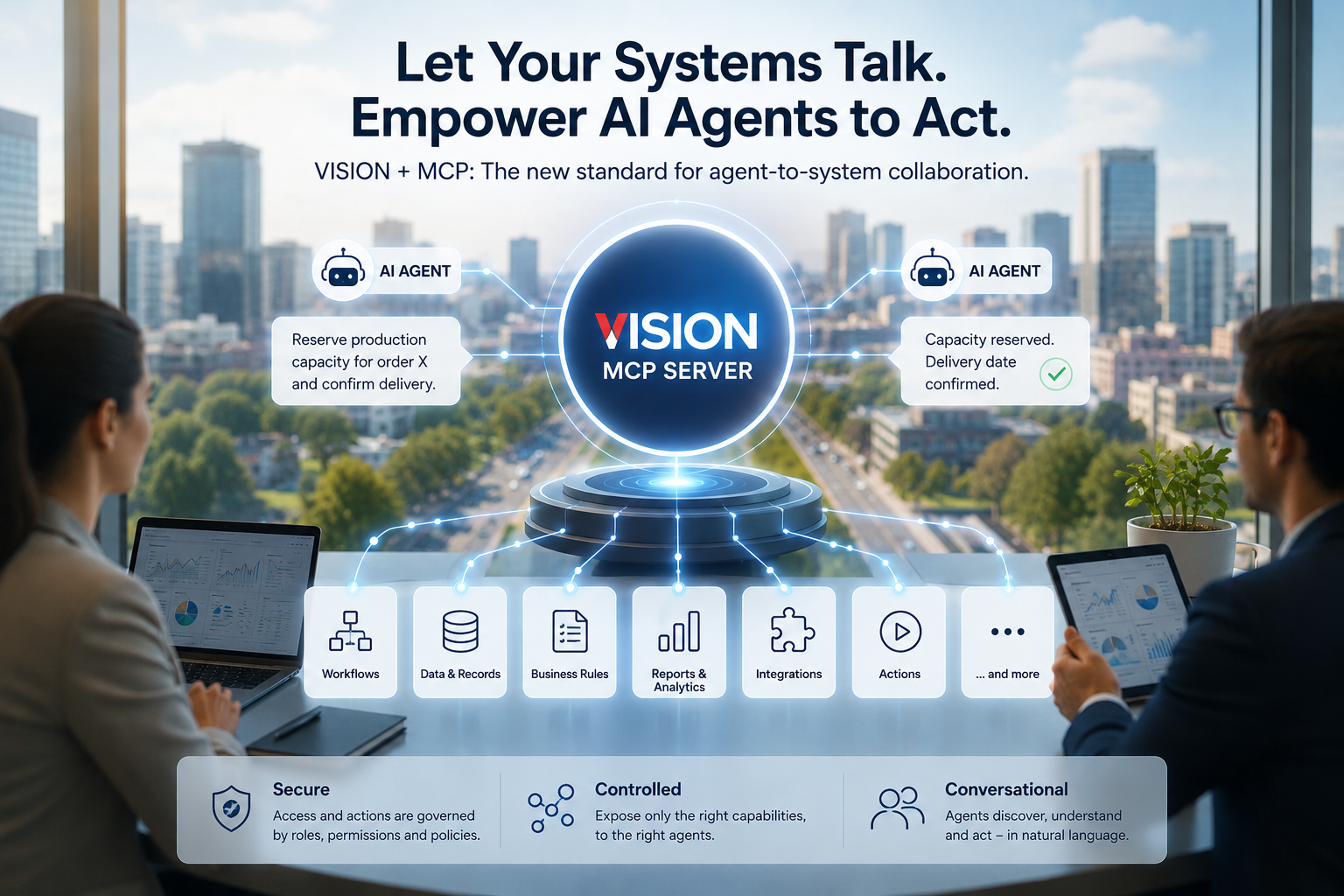
An AI agent from a partner company receives a task: “Reserve production capacity for order X and confirm the delivery date.” It does not study API documentation or search for the right endpoint. It asks your platform what it can do, identifies the relevant capability, submits the task, and receives the result. No file exchange. No manual mapping. No integration project built from scratch.
That is the shift now taking place.
From Data Exchange to Agent Collaboration
The next generation of interoperability will not be limited to moving data between systems. It will increasingly involve AI agents that discover capabilities, delegate tasks, trigger workflows, and interpret results across platforms and organizations.
A traditional API works through a fixed technical contract. The consuming application must know the endpoint, parameters, request structure, and response format.
An AI agent can interact differently. It can ask, in effect, “What can you do?”, understand the available operations, choose the right one, and act. The system becomes more than a rigid interface. It becomes an active participant in an operational conversation.
This is where MCP — Model Context Protocol — comes in.
MCP provides a standardized way for applications to expose tools, resources, and context to AI agents. Instead of creating a separate integration for every partner or use case, a platform can expose its capabilities through an MCP Server. Authorized agents — internal or external — can then discover and use those capabilities in a consistent way.
Vision Is Preparing for the Agent Ecosystem
For Vision, this is not just a future concept. Vision platforms are being developed so that processes, data, and business actions can be exposed to AI agents through MCP Server components.An authorized agent could ask a Vision application to:
- trigger a workflow;
- validate an order;
- update business data;
- check the status of a process;
- generate a report;
- execute a configured business action.
Vision performs the task within the defined permissions and business rules, then returns the result in a form the agent can understand. The interaction is no longer built only around files or one-off integrations. It becomes a controlled dialogue between systems and agents.
Vision App Maker: Building Applications for People and Agents
This direction is becoming part of Vision App Maker through a dedicated MCP Server component.
The goal is simple: applications created in App Maker should be usable not only by people, but also by AI agents.
Today, you may build an application for order management, contract approval, customer service, reporting, or internal operations. Tomorrow, the same application can expose selected business capabilities to agents without rebuilding the process or creating a separate integration layer for each use case. You define what the application can do, under which conditions, and with which permissions. The MCP component makes those capabilities discoverable and usable in a standardized format.
Vision App Maker therefore becomes more than an application-building platform. It becomes a place where organizations create active participants in an agent-driven economy — systems that do not only store and display information, but also receive tasks, execute actions, and return results.
Why This Matters Now
The next competitive advantage will not come from having the largest number of APIs. It will come from making business capabilities easy for AI agents to discover and use, without losing security, governance, or control. Vision is building the infrastructure for that transition.
The future in which systems stop exchanging files and start talking is not ten years away. It is already taking shape.
The real question is whether your systems will be ready to answer when an AI agent starts the conversation. Follow the conversation on LinkedIn and Facebook.