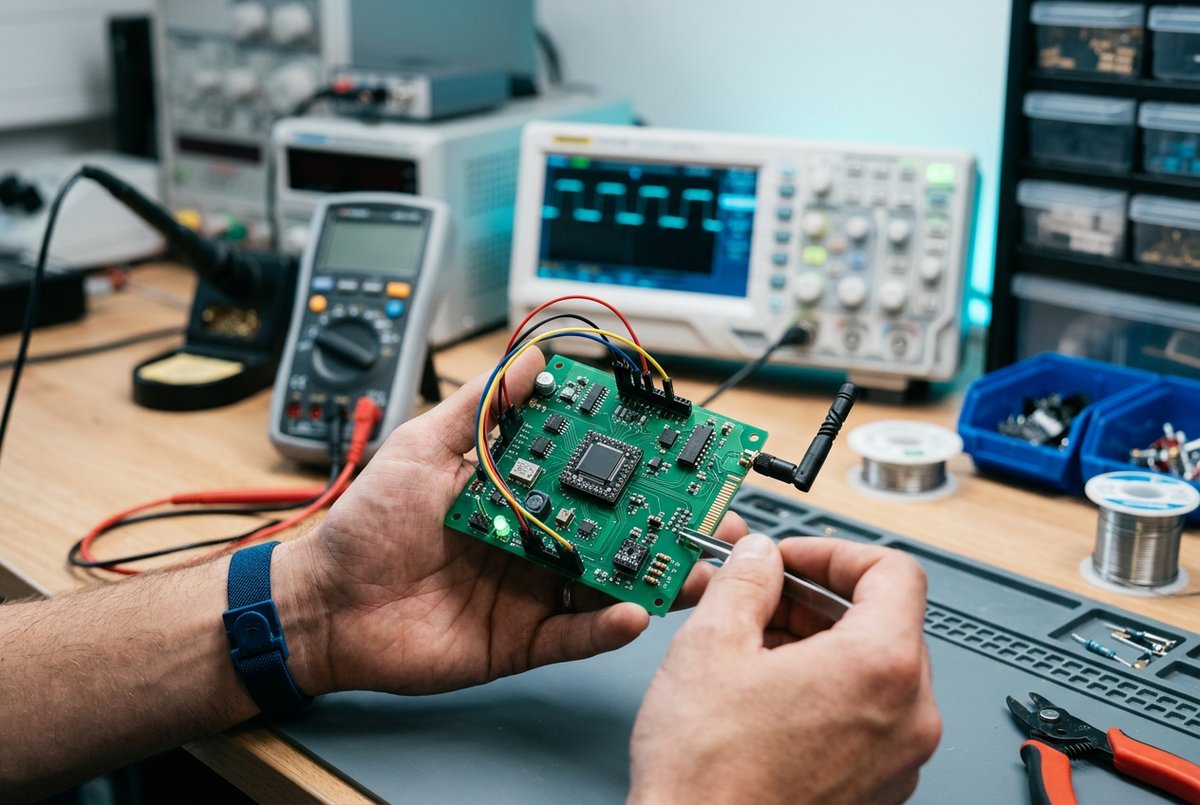
VISION builds software and connected hardware for organisations that move people and goods: public transport operators, municipal transport departments, road and infrastructure authorities, and companies running vehicle fleets. The work spans business analysis and process design, custom software and platform configuration, hosting and infrastructure, and IoT devices, sensors and hardware prototyping.
Mobility systems are rarely built in one go. Ticketing, vehicle tracking, street lighting, cameras and permit registers tend to be bought years apart, by different departments, from different suppliers. We start by describing the equipment and processes that already exist and then connecting them, so the operational picture sits in one place and existing systems stay in service.
Public transport and passenger information
VISION develops smart bus station technology that brings real-time arrival information, passenger flow monitoring and connected services to the stop itself. Operators get a view of how stations are used; passengers get information where they wait.
Stations, vehicles and city systems have to stay in contact across a whole urban area. We design and deploy mesh-based infrastructure for that connectivity layer, so equipment at the kerbside keeps reporting in places where fixed links are awkward or expensive to run.
Vehicle and fleet tracking
Tracking solutions give live visibility across vehicles, fleets and mobile assets, supporting public transport management and logistics from the same data: where a vehicle is and how it is being used. Positions and readings arrive as measurements against a known asset, so they can be charted, compared between periods and used in rules.
City infrastructure in one operational layer
Through Vision Smart Platform, street lighting, environmental sensors, metering and video detections are held in a single registry. Every domain uses the same three levels — model, version and instance — so mixed equipment from several suppliers and generations is described rather than standardised.
One interactive map carries the layers and filters for all of it. Rules combine conditions across domains, such as a detection, a reading and a time of day, and trigger commands, notifications or parameter changes with priorities. Organisational units and roles decide who sees and who acts, practically every entity carries a change history, and integration APIs let GIS and ERP systems read the same data.
Transport permits and municipal administration
For city transport departments, the Vision Smart Digital City transport module digitalises transport and taxi authorisations, slow vehicles and mopeds, annual visa renewals with expiry tracking, fiscal registration and deregistration of slow vehicles, access permits for weight-restricted zones, and the transport manager register.
Applications arrive at the counter or through the citizen portal. Vehicle technical data, filed documents and verifications stay with the file, authorisations are issued with a digital signature, and renewal alerts are raised automatically. The module comes with its forms, workflows, registries, templates, business rules, notifications, reports, dashboards and audit trails already configured, and shares payments, electronic registry, document management and notifications with the rest of the platform.
Built around your processes
Behind this work sits Vision App Maker, the configuration platform used in more than 100 implementations. Data structures are defined in a visual designer: types, cardinalities, lists, parameters and entities. Forms and responsive interfaces are generated from them, business rules are written in a rules engine usable by anyone comfortable with formulas in a spreadsheet, and workflows are drawn in a visual editor. Integrations with ERP, CRM or legacy systems are added through a plugin mechanism.
When a route changes, a permit gains a step or a new class of vehicle has to be registered, the configuration changes with it.