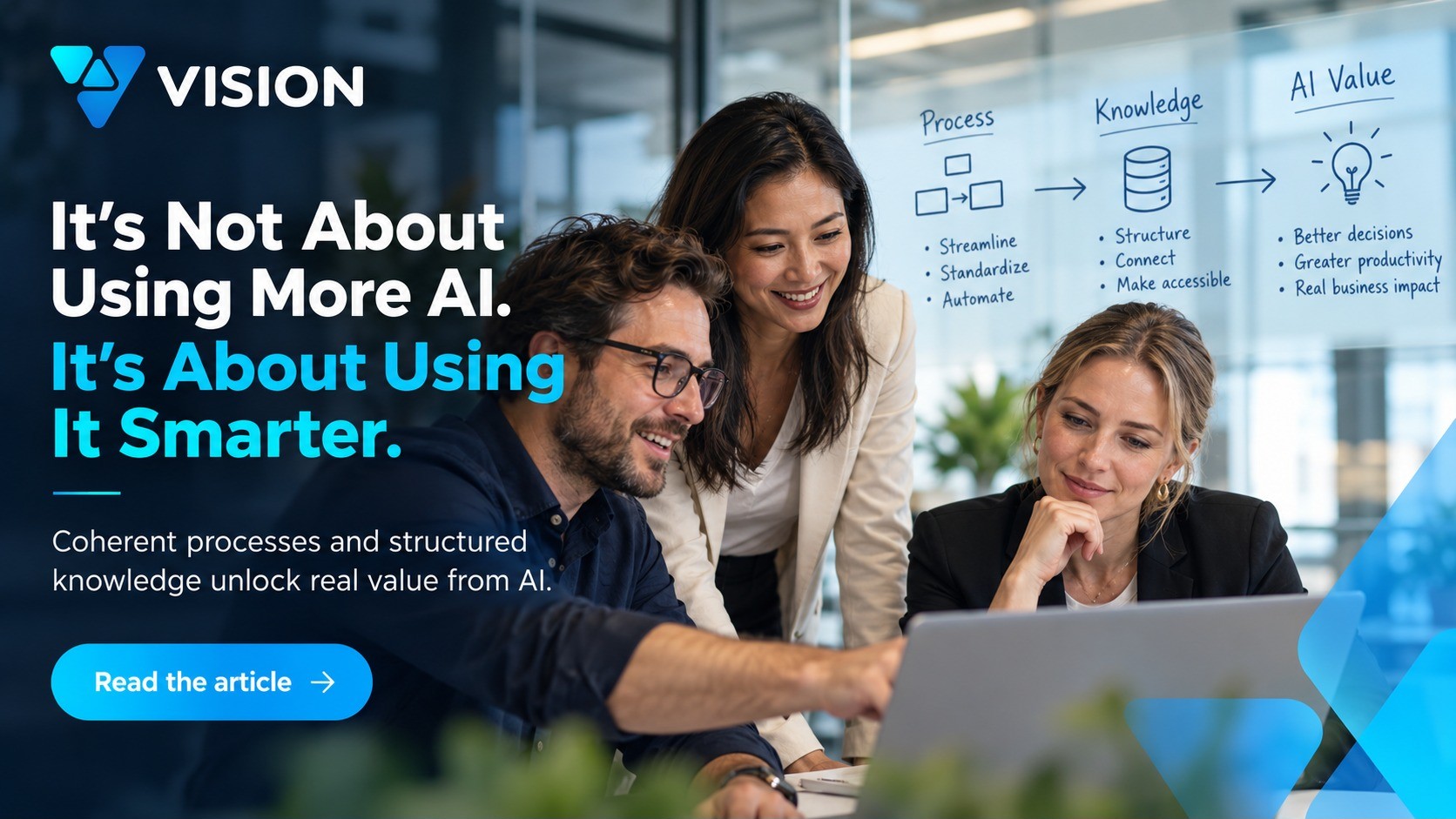
Why coherent business processes and organizational knowledge are essential in the AI era.
The future belongs not to organizations that use the most AI, but to those that integrate it most effectively into the way they work.
Artificial intelligence already helps us complete in minutes tasks that once took hours. Yet there is a paradox: we can become significantly more productive as individuals without necessarily becoming more efficient as organizations.
When business processes are fragmented and information is scattered across applications, documents, and multiple versions, AI risks amplifying existing problems.
We generate reports, proposals, analyses, and specifications faster — but also more versions of the same information. Some are current, others are outdated. Over time, we spend increasing effort identifying what is actually correct.
AI can accelerate not only productivity, but also organizational chaos.
From Automated Tasks to Coherent Business Processes
Most organizations begin their AI journey by automating individual tasks. The benefits are real, but organizational efficiency emerges when these activities become part of well-defined, interconnected business processes.
Consider a software company. A sales opportunity leads to a proposal, then a contract. The contract defines deliverables, the project organizes execution, and the results are tested, accepted, and eventually invoiced.
These are not isolated activities. They are stages of a connected process that should share consistent information and preserve the traceability of decisions.
AI can also help analyze and redesign these processes, drawing on best practices and suggesting improvements.
But AI can recommend. People must decide.
Every organization has its own business model, responsibilities, constraints, and priorities. Automating an inefficient process does not make it a good process. It often just makes inefficiency happen faster.
Business Applications Generate More Than Data. They Generate Knowledge.
There is another important aspect we often overlook: business applications do more than store data and manage operational activities. They continuously generate organizational knowledge.
That knowledge does not live only in documents stored in a Document Management System (DMS). It also exists in business processes, collaborative workflows, decisions, relationships between business entities, configurations, and activity histories.
A software project, for example, produces more than documentation and deliverables. It generates design decisions, solutions to problems, reusable components, and experience that can benefit future projects.
Much of this value remains fragmented across applications and documents.
This is why the traditional concept of Document Management is evolving. Storing, organizing, and versioning files is no longer enough. Documents need to be connected to the data, processes, decisions, and business context in which they are created and used.
We are moving from managing documents to leveraging organizational knowledge.
Knowledge Hub, MCP, and AI Copilot: The VISION Approach
At VISION, we are already integrating this approach into the evolution of our platforms and solutions, particularly Vision365.
We are developing the Knowledge Hub concept as a cross-cutting capability of business applications, connecting information and knowledge generated through documents, processes, collaboration, and operational systems.
Three complementary capabilities support this approach:
- Knowledge Hub — structures and connects organizational knowledge within a unified business context.
- MCP (Model Context Protocol) — enables AI tools and agents to access application information, relationships, and capabilities through controlled interfaces.
- AI Copilot — brings AI directly into application interfaces and business workflows, providing contextual assistance and supporting task automation.
We are developing these as reusable capabilities across the VISION ecosystem, enabling AI agents to work with consistent, contextualized information rather than isolated documents or outdated fragments.
In this model, AI can connect sales opportunities with available solutions, reuse specifications and decisions from previous projects, or identify functionality that can be turned into reusable standard components.
We are moving from applications that store data and execute processes to applications that continuously capture, connect, and leverage organizational knowledge.
AI Efficiency Starts with Organization
The value of AI depends on more than model performance or the number of automated tasks.
It depends on how coherently business processes are defined, how well information is organized, and how effectively organizational knowledge can be reused.
AI can help us design these mechanisms and then automate them. But people must remain responsible for direction, priorities, and decisions.
AI can help us work faster. Coherent processes and structured knowledge are what enable us to work better.