
Why business semantics is becoming the common language of people, systems and AI agents.
Connecting AI agents is no longer the difficult part. Protocols such as MCP let an agent read data from an application, call its functions and pass the result to another agent.
The difficult part is what happens next. Two agents can exchange messages perfectly and still misunderstand each other.
The connection is technical. The meaning is business.
The Same Word, Three Different Numbers
Ask three people in a company what "available budget" means. The financial controller subtracts what has been invoiced. The purchasing manager also subtracts what has been ordered. The department head looks at what was approved at the start of the year.
People resolve these differences in a meeting. AI agents do not hold meetings. An agent that checks an invoice and an agent that prepares a purchase order will each use the definition they find, and each will be confident.
When every agent, report and integration carries its own interpretation, automation does not remove misunderstandings. It multiplies them, faster.
From Field Names to Business Terms
Systems have always talked to each other in technical language: tables, fields, codes. The business meaning stayed in people's heads, in procedures and in the logic written inside each application.
Business semantics changes the starting point. The organization defines its terms once, in a business glossary, and every term is linked to what implements it in the application:
- What things are — entities and their attributes: a client contract, an invoice, a budget line.
- What is measured — measures with one definition: available budget, approved cost, billable hours.
- What can happen — states and actions: an invoice is in processing; "approve the invoice" is a named action.
- What must be true — constraints, policies and parameters: the invoice stays within budget; above a threshold, a second approval is required.
A term also carries the synonyms the company actually uses. If your teams say "available" and the application says "available budget", both lead to the same definition.
The glossary is layered: common terms shared by all applications, terms specific to an industry or a product, and the terms of one particular organization. A lower layer can make a term more specific. It cannot contradict it.
How Agents Use the Same Language
With a glossary linked to the application, an AI agent no longer needs to guess which column holds the right value. It asks for a term and receives the definition, the rule that computes it and the constraints that apply.
Take an agent that reviews supplier invoices. It does not reason about tables. It checks named constraints: the invoice is within budget, the allocation is complete, the supplier's bank account has not changed recently. Each check has one definition, the same one people see on screen and the same one used in reports.
When the agent passes its result to another agent, or to a person, it passes terms, not raw data. "Invoice within budget: failed. Available budget for this line and month: exceeded." The next agent, the approver and the auditor read the same thing.
And the agent does not act alone. Its proposal reaches a person as a normal approval task, and the decision is recorded: what was decided, by whom and on what basis.
Agents propose in business terms. People decide. The log keeps the reasons.
Systems That Talk Business
The same vocabulary applies between systems. An integration usually announces that a record changed. A business event says what actually happened: a contract was activated, an invoice was approved.
When events have stable names and definitions in the glossary, the receiving system does not need to interpret status codes. It reacts to a business fact that means the same thing on both sides.
This is how applications, integrations and agents built at different times can still understand each other: they share the meaning, not just the format.
The VISION Approach
At VISION, we are building business semantics as a capability of the Vision App Maker platform, so that the solutions built on it, starting with Vision365, can use it without redefining it.
In Factory Studio, terms are not a separate document. Each one is linked to the rules, screens, workflow steps and data that implement it, and the links can be seen as a map. When a definition changes, you can see what depends on it.
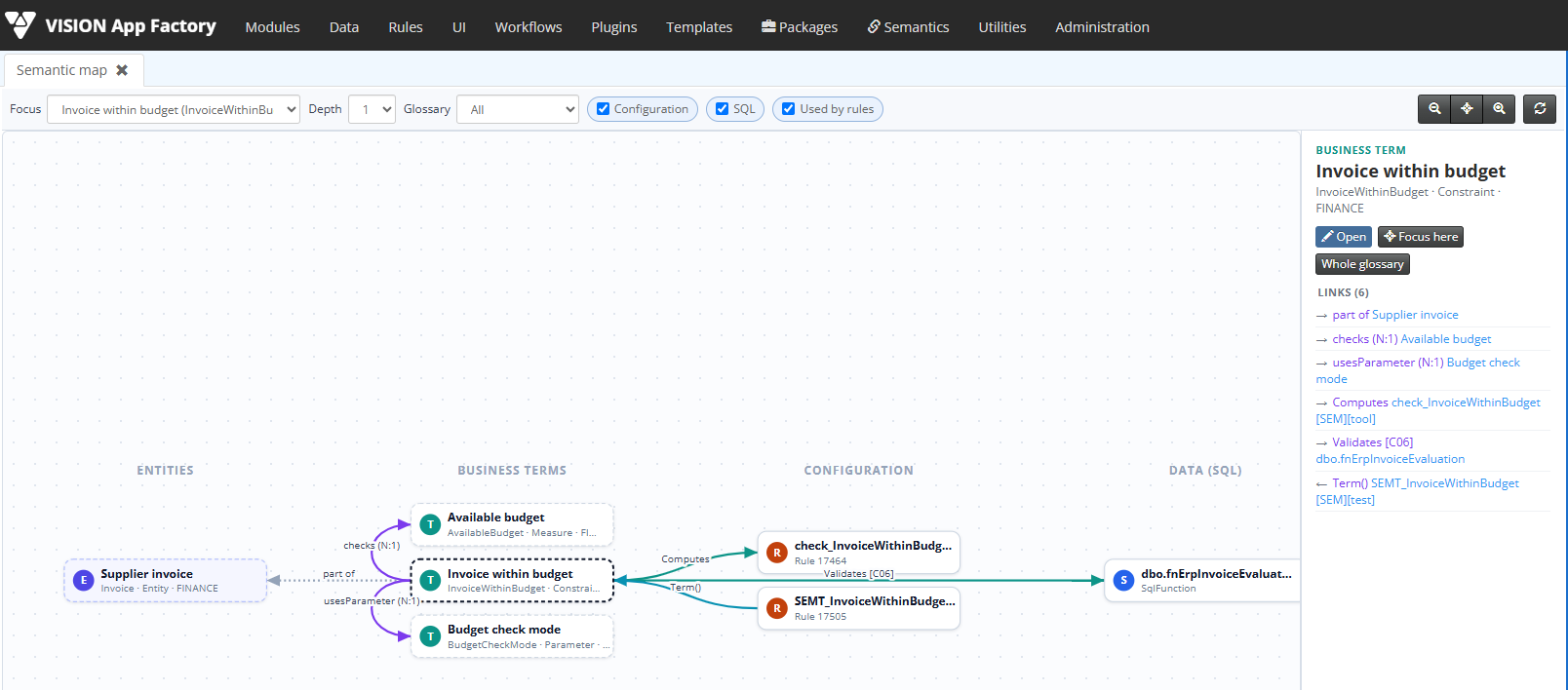
The business term "Invoice within budget" and its links in the Vision App Factory semantic map: the entity, the measure it checks, the parameter it uses, the rules that compute it and the data that validates it.
The same glossary is available to AI tools through MCP, so an assistant or an agent works with the organization's own terms, under the same rules and approvals as any other user.
The person who approves the invoice never opens the glossary. In Vision365 they see its result. When an invoice is not approved automatically, the screen explains why in the same terms: which check failed, which measure caused it and what the agent proposes. The decision stays with the person, and it is recorded in the decision log.
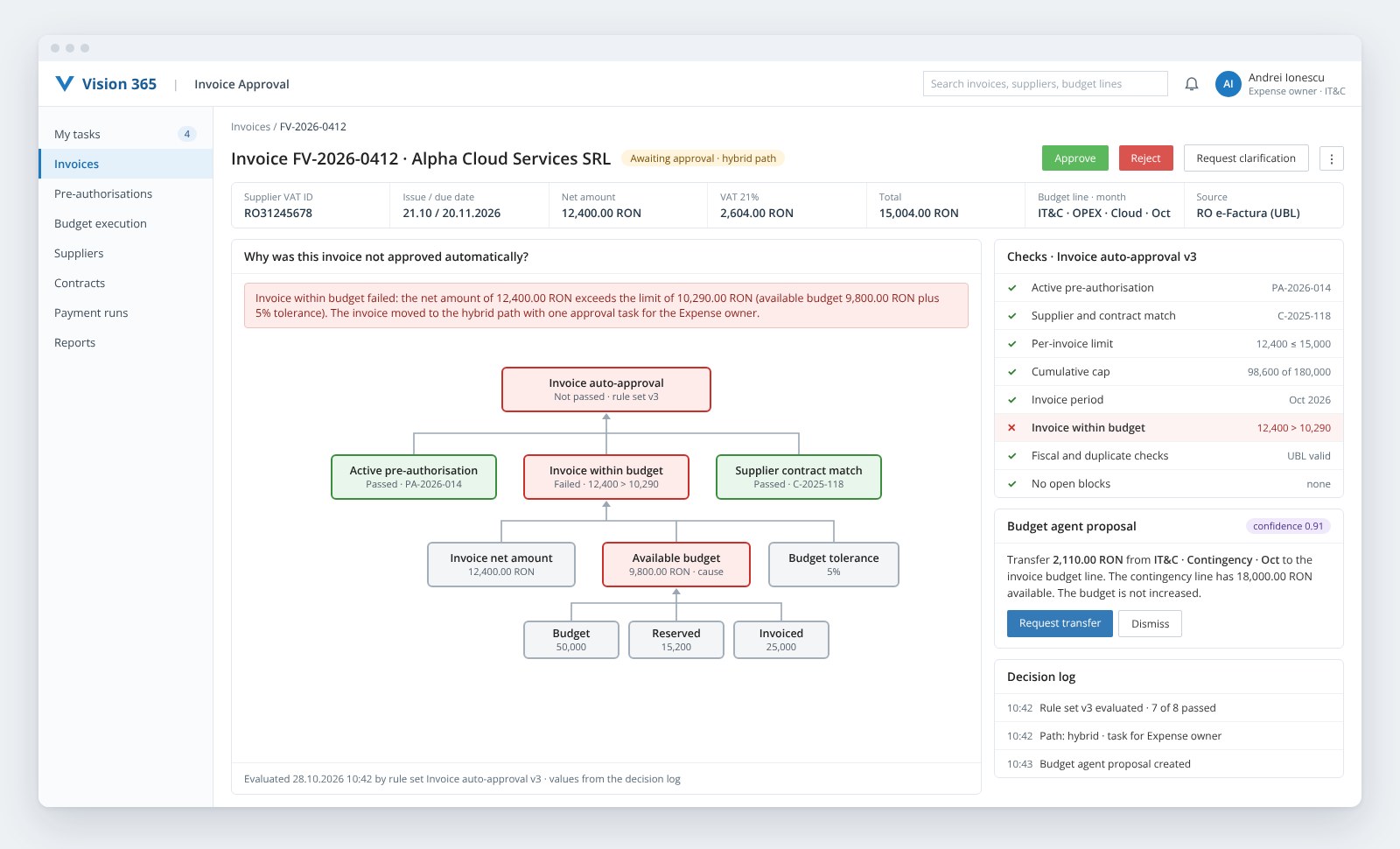
What the approver sees in Vision365 (illustrative design, demo data): the failed check "Invoice within budget", the terms it depends on, the agent's proposal and the decision log.
Meaning Comes First
More agents will not make an organization smarter if each one understands the business differently.
Before asking how many processes AI can automate, it is worth asking a simpler question: do our people, our systems and our agents mean the same thing when they use the same word?
AI can speak any language. It is up to us to teach it ours.